奥巴马 2008!
Published 2008-10-28
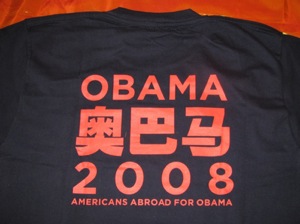
Courtesy of James Fallows, I learned that the Mandarin transcription of “Obama” is 奥巴马. I’ve written previously about the danger of “translating” foreign words from Chinese based on their characters, which are chosen primarily for their calligraphic appearance, not their semantic meaning. But it’s fun to do anyway.
Also, as soon as I saw this t-shirt I realized “I can read those characters!” Of course, those characters say “Obama,” helpfully translated above, but still: a fun party trick.
奥 is a common character for foreign transcription, usually for the long o or ah sounds. You find it in the Chinese words for Austria (奥地利), Australia (澳洲), and Olympics (奥林匹克). It means “mysterious.”
巴 is (I think) a noun particle (and thus essentially meaningless); dict.cn also translates it as “hope” which is very fitting indeed. I recognized it as the sound-part of the second character in 酒吧, which is the Chinese word for “bar” (as in “the place where you get drunk”).
马 means “horse,” which is the core of a common Chinese tongue-twister. Again, this is a common character for transliterations of foreign words; last year for example, Jenny and I ran in the 厦门国际马拉松.
So, the literal, direct, character-for-character translation of the Chinese transliteration of “Obama” is “Mysterious hopeful horse.”
…
This post comes in the midst of a little nostalgia Jenny and I are feeling for Xiamen. For example, scarcely a week goes by when we don’t lament our inability to get noodles from Bu Er Zhai.
One of my coworkers is leaving this week for a tour of Afghanistan and Pakistan, which prompted some conversation around the office about life as a foreigner or outsider. In relaying this to Jenny I realized what I really missed about living in China: I am no longer special. In Portland, I’m just another white guy on a bicycle, a demographic pretty well represented here anyway. In Xiamen, it was impossible not to attract a lot of attention everywhere we went. So, to our neighbors we were special, because we were 老外. And to our friends and family “back home,” we were the exciting couple living an adventurous life in China.